An Introduction to Buddhism
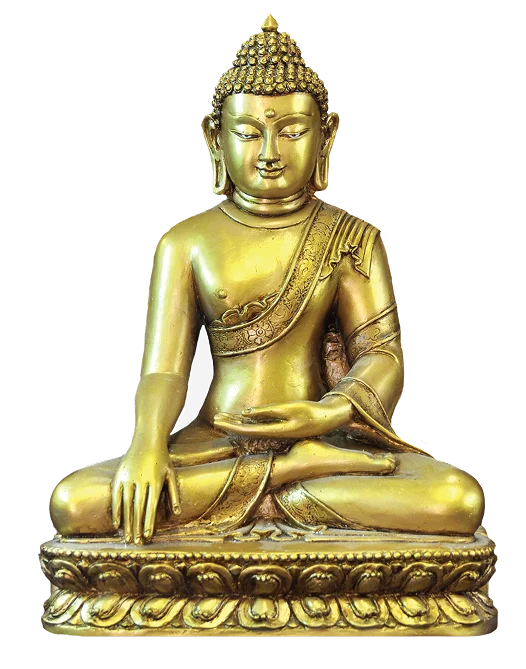
Image Caption
The Buddha-to-be left his lavish lifestyle as a young man to embark on a spiritual quest as a homeless ascetic. He studied with two meditation masters, then undertook an extreme practice of bodily neglect. His discovery of the middle way set him in a different direction, with the realization about the context in which one lives one’s life matters: although success lies in the direction of abandoning wants, abandoning one’s bodily needs leads to failure. Shortly after that, he awakened in meditation under the bodhi tree. Thereafter, he embarked on a forty-five year teaching career, so that others might replicate his attainment.
The Buddha called the body of his teachings Dhamma-Vinaya. Through the Vinaya the Buddha reformed the ascetic community, delineating in fine detail the way of life required of his ascetic disciples, within the framework of the middle way, in order to optimize the results of practice. The community of persons who undertake Vinaya practice, whom he called the “monastic Saṅgha” (bhikkhu-saṅgha), constitute to this day a kind of counterculture of awakening. Vinaya literally means “lead away,” for it leads one away from the soap-operatic life of the common worldling. Since the life of the monastic (both monks and nuns) is highly regulated, Vinaya is generally translated as “The Discipline.”
Through the Dhamma the Buddha defined a detailed course of practice in the skills of virtue and wisdom that eventually culminate in what we can regard as the perfection of human character: “awakening” (bodhi), or nibbāna (nirvana). The Buddha made the Dhamma available to the entire community (purisā) of monastics and householders, with the understanding that householders, balancing many worldly concerns and responsibilities, would avail themselves of the Dhamma, and enter into Dhammic practice at any level they chose. Those householders who embraced practice with wild abandon were welcome to enter the monastic Saṅgha, if circumstances allowed, to provide themselves with the optimal context for quick progress. Although the bulk of the Buddha’s discourses (Dhamma talks) were directed to monastics, by associating with monastics, by learning Dhamma and by emulating aspects of monastic life, dedicated householders could also make significant progress in their practice outside of the context of the Saṅgha.
For both monastics and householders, a turning point in practice is reached with “stream entry,” classified as an initial level of awakening. Based in ethical development, in a high degree of wholeheartedness and commitment to practice, and in an kind of perceptual insight called the “vision of Dhamma,” stream entry makes one fully equipped to start out on the “noble eightfold path” (= the stream), a rigorous, sophisticated, multifaceted course of training in virtue and wisdom. The Buddha reassigned the word “noble” (ariya) to characterize those who had quietly reached stream entry or higher attainments, and designated the community of the noble ones “the noble Sangha,” distinct from, but substantially overlapping with the monastic Sangha. This gives us the structure of the Buddhist community and the way practice is sustained at different levels that is still common throughout Buddhist Asia today.
The modern encounter with Buddhism
Not surprisingly, Dhamma and its practice, products of an ancient age, challenge modern people in many ways. However, when taken up, they prove remarkably fresh and relevant, and if they didn’t challenge us they would fail to take us beyond our materialistic, individualistic, competitive, and distracted modern lives to higher levels of attainment. Compare, for instance, how removed our modern lives—not mine: I’m a monk—from the optimal context for the pursuit of Dhamma practice identified by the Buddha. Compare how greed is often extolled as the driving force of human progress in modern cultures, while regarded as a primary defilement and source of suffering in Buddhist thought.
One distinguishing characteristic of modern Buddhism is the prominence it gives to meditation. Many modern teachers teach only meditation, teach that meditation is the heart, if not the entirety, of Buddhist practice, or that meditation is the fast track to awakening. In fact, in early Buddhism meditative states (samādhi or jhānas) take on a significant role only in very advanced stages of practice, where they indeed become critical, particularly in the perfection of wisdom. Samādhi is accordingly listed as the last factor of the noble eightfold path classified, and categorized as a faculty (indriya), along with the two preceding factors (“effort,” and “conscientiousness,” often translated “mindfulness”). A faculty fulfills an auxiliary function in enabling the wisdom and virtue factors, one that optimizes the personal discovery of new ways of seeing and behaving, largely through producing altered states of consciousness.
Nonetheless, I recommend taking up a meditation practice as soon as possible, even in a stand-alone non-Buddhist form. Right from the beginning, a meditation practice will establish in one’s life aspects of a proper context for practice at any level. Meditation practices tend to slow anxiety and the frenetic experience of modern life, provide positive states of mind, and reveal hidden potentials of the human mind. Moreover, cumulative skill in meditation can be relatively easily repurposed for the role it plays in advanced practice.
My short introduction to early Buddhism, WDMP, takes particular care with presenting Dhamma practice from a modern perspective, with advice on the difficult task of integrating these ancient teachings into modern life. A significant part of this is tweaking one’s modern way of life to better conform with a proper context for practice.
[BOOK element: Where Dharma meets Practice]
Elements of Dhamma practice
Dhamma is like a cookbook. It is a support for practice, specifically the “practice of Dhamma” (Dhamma-paṭipatti). That is the function of Dhamma. The word “practice” in everyday usage designates something we do repeatedly or habitually. It has either, or both of two primary functions:
- A practice produces results (typically desired results) as we perform it. This is why we call various occupations “practices,” like a doctor’s practice.
- Through practice we acquire, refine and internalize skills. This is why we call various activities like playing the tuba every afternoon after school to the annoyance of neighbors “practice.”
There are other functions of practice; ritual practices performed as a group—for instance, singing Auld Lang Syne at the beginning of the new year—serves as a means of socialization. The practice of Dhamma results in both immediate benefits and the acquisition of skills: - The practice of Dhamma conforms with ethical behavior, and calls for high attentiveness and diligence, each of which provides beneficial results on a daily basis.
- Through the practice of Dhamma we acquire, refine and internalize the skills of virtue (sīla) and wisdom (paññā) as qualities of character, the first driving behavior, the second driving our perception of the world. We also improve faculties, such as meditative states, that optimize practice in both of these ways.
As the practice of Dhamma advances increasing emphasis is placed on skill acquisition (2). It is (2) that transforms us into a different kind of person. When this training is carried to completion, we have attained the highest standard of human perfection, we are arahants, fully awakened ones. Our lives fulfill their purpose, and our presence manifests as a light in a world of darkness.
The Dhamma is very practical in fulfilling these functions. Its purpose is not to answer the kinds of questions that science or philosophy are meant to answer. Nonetheless, it works intimately with the mechanisms of the mind in order to to retrain even our subtlest cognitive habit patterns in more skillful directions. Significantly, it discovers the roots of human virtue in the nature of mind, rather than in a set of culturally bound conventions imposed on individual behavior. Moreover, Dhamma dares to challenge commonplace concepts of reality, attributing them to presumptive conceptualizations generated by mind. These profound aspects of Dhamma have a lot to offer modern science and philosophy, and in fact its philosophical implications have fascinated western thinkers, to the extent they have been understood, for nigh on two hundred years.
For an introduction to the specific aspects of Dhamma practice, click on “Study & Practice” on the menu bar above and explore the drop-down menu. The practice of Dhamma in early Buddhism is explored most thoroughly at an introcutory level in my book BLBP. Significantly, it distinguishes practice before and after stream entry, that pivotal attainment that enables full possession of the noble eightfold path.
[BOOK element: Buddhist Life/Buddhist Path]
Early Buddhism and later traditions
The Dhamma was formulated by the Buddha, certainly under the influence of the culture, religious, and philosophical milieu that prevailed at the Buddha’s time and place. But much as a language evolves with time and geographical dispersion into diverse dialects, so did the Dhamma evolve into diverse sects and schools. Presumably this process began during the period of early Buddhism, perhaps some two hundred years. The original teachings of the Buddha were delivered at the beginning of that period, and there is reason to think that the EBT closely reflects those original teachings: we see a high degree of coherence, and the evidence is that the texts were preserved with remarkable accuracy in memory far beyond this period.
Although one might initially expect later traditions to degenerate with time, that does not seem to be generally the case.
BUDDHA ON WHAT IS (NOT) DHAMMA
To be an English (Japanese, Navaho, etc.) speaker is belong to or align oneself with a community that shares a set of conventions: principles of grammar, a lexicon, semantic intentions, thought structures, etc. But these shift with time and place to produce dialects that more-or-less share the same set of English elements. To be a Buddhist is to belong to or align oneself with a community that shares Buddhist principles, values, norms, procedures and practices, etc. But these have shifted with time and place to produce various sects or schools that to a greater or lesser degree share the same set of Buddhist elements.
The typical historical Buddhist has probably understood and abided by a Buddhist ethical code, practiced kindness and generosity, harmonized reasonably well with neighbors, helped support ascetics, and held awakening and the Buddha in high regard, even as sacred. They have not been a meditator, and have had little, no, or an erroneous idea of what awakening is, other than that it is something very, very special and that some people achieve it. They have also believed that by being very good they are likely to be reborn into a heavenly realm, to dwell there a very long time. They have known that there is much they do not understand, but are confident that there are wise ones who can instruct them as needed.
English was never invented, but consolidated itself into a social construct, and maintains itself almost as a living organism thought communal interactions of individuals, none of whom fully understands what they are a part of. Buddhism was actually invented as a social construct, but only once, at its early inception. Moreover, build into its design is an enduring Saṅgha of “noble ones” charged with upholding and teaching Buddhist standards. Also built in at its inception was an intense but optional a path of study and practice that produces progressive virtue and wisdom as acquired qualities of character, generates “noble ones,” and ultimately results in individual awakening, to the benefit of the entire Buddhist community.
Further study
WDMP
BLBP
Bodhi, In Buddha’s Words
The Nikāyas