Wisdom Teachings
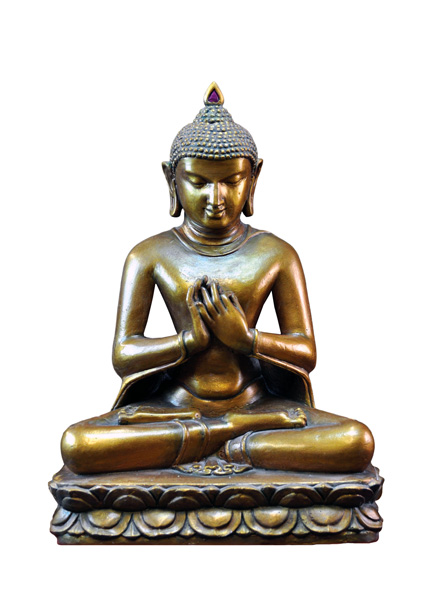
Image Caption
The Buddha once said,
The wise one established in virtue,
Developing composure and wisdom,
That ardent and prudent monk,
It is he who disentangles his tangle.
The practice of virtue tames the greed and aversion that so poorly serve the well-being of ourselves and others. Yet the impulse for greed and aversion is held in place by delusion, our conceptual misperception of the world in which we live. The practice of wisdom removes such misperception. The passage above sees this practice as a process of disentangling ourselves from the knotted mesh of our problematic, samsaric lives. Virtue loosens the grosser tangles and gives us space to deal with the tighter, thornier knots of delusion.
The practice of wisdom begins with right understanding and is perfected in composure. It starts with developing a conceptual grasp of the human condition, proceeds through the discovery of this condition in our own lived experience, and concludes with a full internalization of Dharma. This is a matter of achieving “knowledge and vision of things as the really are,” the precursor to complete awakening.
The human dilemma begins with ignorance. In our ignorance we presume too much. We presume a world out there, we presume a world in here, we presume a self both in here and out there. We presume a metaphysics that fills the outer world with substantial self-existing objects. Unfortunately we presume a world that is impossible to live in, in any satisfactory way, and we suffer for it. The fixed objects we presume matter to us, either as enticements or threats, and therefore evoke craving and appropriation. Our individual identity becomes defined in terms of what we appropriate. But these objects and the person we’ve become have in fact been insubstantial and contingent all along. We suffer as we grasp for solid ground that is simply not there. We’ve been caught in this soap opera of life for a long long time, and without a way out, we will be caught in saṃsāra for a long time to come.
In dependent coarising (Pali, paṭicca samuppāda) the Buddha explores the things that afflict us, how they arise, and what happens when we let go of them. We discover that they are part of a tangled and knotted mass of conditional dependencies, cross dependencies, circular dependencies, in which each knot in the snarl – held in place by the neighboring tangles – is a challenge to unravel. The twelve-link chain of dependent coarising is a single thread discovered by the Buddha that twists through the snarl, but that, if we follow it, allows us to proceed systematically, to unravel one knot after another (twelve in all), until the entire wad becomes disentangled and we are released from the human dilemma.
The teaching of the chain of dependent coarising is among the deepest teachings of the Buddhavacana, in which the conditioned arising of the illusory self caught in saṃsāra plays a staring role. The chain is an entrance into an understanding (1) of the nature of the human dilemma, that is, how we have managed to get ourselves so ensnarled in saṃsāric existence, and, at the same time, (2) of the resolution of that dilemma, that is, how we can weaken or break that chain and attain liberation.